0413_RTHQ_ORD_CEP_BLK_ZS_EX_Cephanopod_1_2.25x2.75
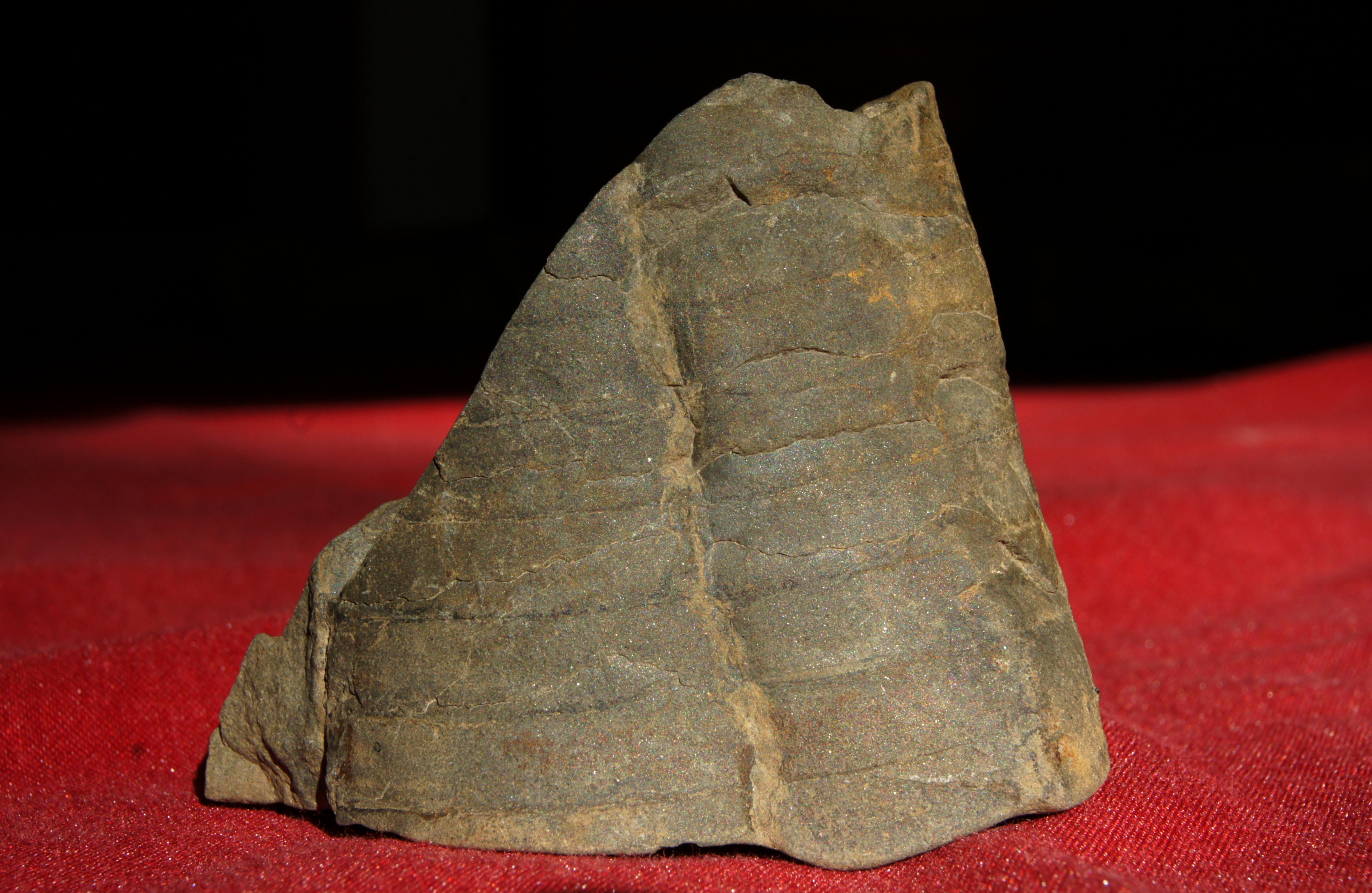
Petit bloc à céphalopode orthocône probable
Bloc fossilifère à céphalopode orthocône probable
Animalia
Mollusca
Cephalopoda
Orthocerida
Scientific identification
- Common name
- Orthoconic nautiloid cephalopod
- Author
- Denis Arcand
Specimen interpreted as a small orthoconic cephalopod preserved in matrix, likely represented by part of a straight conical shell or internal mold. The fossil appears to correspond to a single main cephalopod specimen rather than an assemblage.
Supported by: The filename encodes CEP (cephalopod) and the keyword 'Cephanopod', interpreted here as a spelling variant of 'Cephalopod'. In Ordovician material from southern Quebec, straight-shelled nautiloid cephalopods are a reasonable conservative interpretation for such catalog wording.
Species-level confirmation requires: Species-level identification would require clearer shell characters such as siphuncle position, chamber spacing, shell section, ornamentation, and better-preserved diagnostic views.
Certainty: The filename and overall morphology support identification as a cephalopod with a straight orthoconic shell. The misspelling 'Cephanopod' in the filename is interpreted as 'Cephalopod'. Taxonomic placement is conservative: secure at class level, probable as an orthoconic nautiloid, but genus and species remain undetermined from the available information alone.
Geology and provenance
- Formation
- Nicolet River Formation
- Group
- Lorraine Group
- Locality
- Écluse de Chambly
- Region
- Richelieu Valley
- Province
- Quebec
- Country
- Canada
Lithostratigraphy
Locality: CEDC- Chambly Écluse de Chambly
Region: Richelieu Valley
Formation: Nicolet River Formation
Group: Lorraine Group
Depositional environment: Soft muddy seafloor
Note: The filename identifies the specimen as an Ordovician fossil from site code RTHQ. The nomenclature document indicates that RTHQ is a shale locality in the Richelieu / Chambly corridor, but no confirmed formation or group value was available in the uploaded dropdown data.
Observed lithology
Description: Dark gray fine-grained shale to shaly mudstone forming a compact fossil-bearing block.
Interpretation: Fine marine siliciclastic sediment deposited in a low-energy offshore setting.
Certainty: High confidence
Physical description
Assemblage description: Small matrix-supported block preserving one probable orthoconic cephalopod element. The specimen appears to represent a single principal fossil on a compact shale block.
Associated fossils: No additional associated macrofossils can be confirmed from the available record.
Matrix description
Fossil assemblage: Sparse shelly assemblage
Fossil density: Low
Species composition: Mixed / uncertain
Plate surface: Weathered
Relief: High relief
Ornamentation: Fine growth lines
Rock type: Calcareous Shale
Color: Brown / Dark gray - Mottled - Medium-dark
Shape: Sub-rounded block
Dimensions: W 5.7 × L 7 × T 2.8 cm (centimeters)
Approximate volume: 111.7 cm (centimeters)³
Weight: 220 Gramme
Note: The specimen is treated as a single cephalopod-bearing block rather than a multi-element debris concentration.
Additional note: Dimensions converted from the filename code 2.25×2.75 inches. Support code BLK is interpreted as a compact three-dimensional block rather than a flat plate.
Taphonomy
Summary: Probable orthoconic cephalopod preserved on a small shale block from an Ordovician marine setting.
Evaluator: Paleontologist
Transport origin: Indeterminate
Occurrence position: Indeterminate
Articulation: Moderate
Fragmentation: Moderate
Abrasion: Low
Compression: Low
Observed processes: A single probable orthoconic cephalopod element is preserved on a compact shale block, with limited evidence for strong transport or concentration of multiple skeletal elements.
Interpretation: The specimen likely represents an isolated orthoconic cephalopod remain preserved in fine-grained marine sediment with limited evidence for significant transport.
Taphonomic quality: B — Reasonably informative preservation of a single identifiable fossil specimen
Justification: The specimen is more informative than a fragmentary debris concentration because it preserves a single probable cephalopod individual, but taxonomic resolution remains limited.
Evaluation date: 2026-04-03T00:00:00
Palaeoecological interpretation
Interpretation: Marine nektonic cephalopod remain preserved in offshore muddy sediment.
Hypothesis: The fossil likely represents part of a straight-shelled nautiloid that lived as a mobile marine predator or scavenger above the seafloor in an Ordovician shelf environment.
Certainty: Moderate; cephalopod interpretation is supported by the filename and expected morphology, but detailed ecological inference is limited by the incomplete preservation.
Note: This specimen is chiefly informative as evidence of Ordovician cephalopods in the collection rather than as a fully diagnostic taxonomic reference.
Conservation state
General state: Fair
Integrity: Fragmentary
Alterations: Matrix friability / Crumbling at touch (High)
Stability: Monitor closely
Scientific readability: Poor
Note: Compact but relatively small shale block; edges and fossil surface should still be handled carefully.
Museum exhibition value
Provenance: General locality known only
Systematic collections: Systematic value not assessed
Note: Good educational value as a small straight-shelled cephalopod block, though less visually striking than larger display plates.
Scientific value
Rarity / locality: Representative of typical fauna at locality
Completeness / preservation: Moderately preserved but identifiable
Taxonomic novelty: Typical morphology of known species
Note: Useful collection specimen documenting an Ordovician orthoconic cephalopod from a shale locality in southern Quebec.
Public exhibit text
This small block preserves a probable straight-shelled cephalopod, one of the marine predators that lived in Ordovician seas. Its cone-shaped shell belongs to the group of ancient nautiloid cephalopods.