0584_UNKN_ORD_BRA_PLT_LG_EX_Hebertella occidentalis_1_8x11
Plate with Hebertella occidentalis s
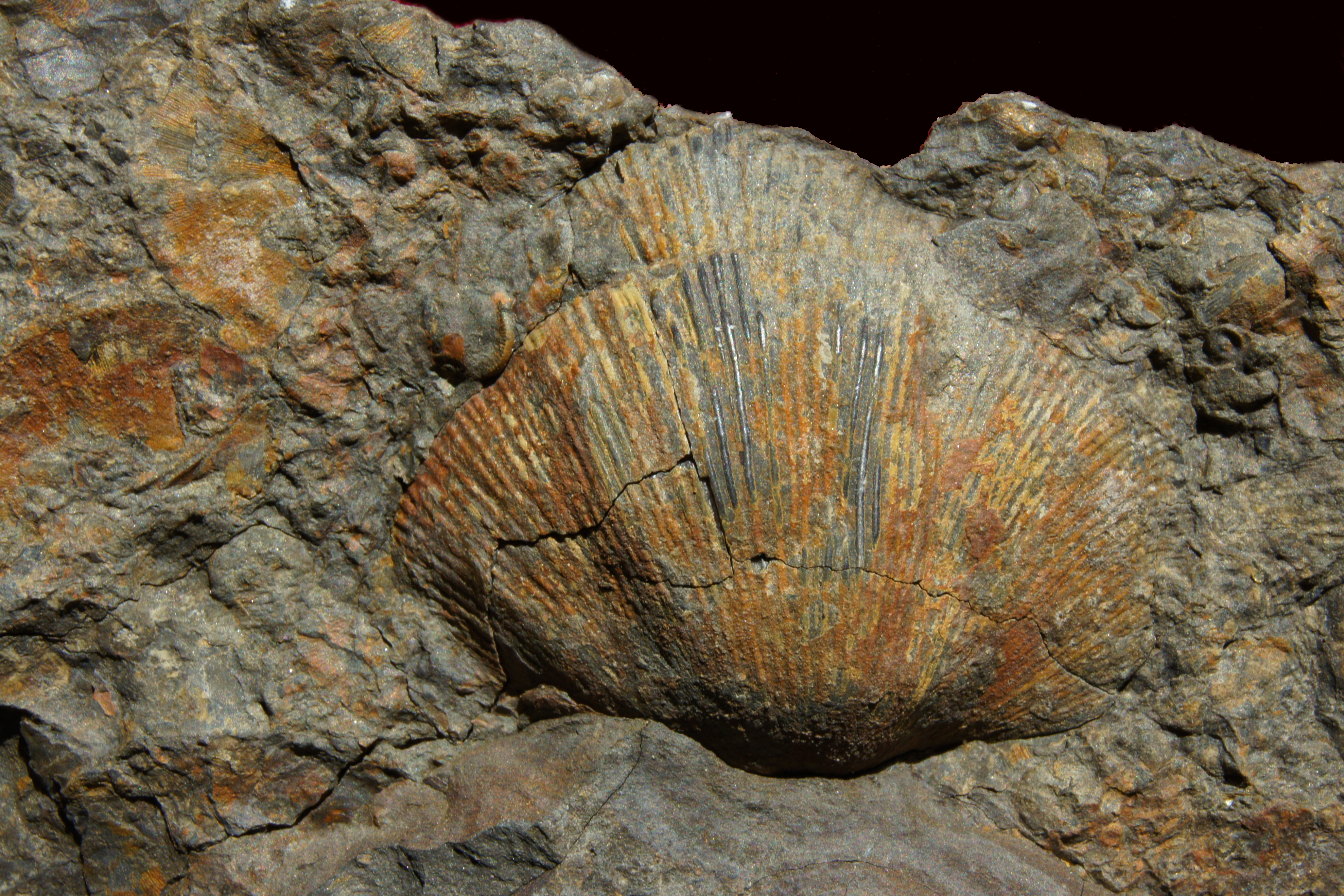
Fossiliferous plate with Hebertella occidentalis and associated shelly fossils
Animalia
Brachiopoda
Strophomenata
Orthida
Scientific identification
- Genus
- Hebertella
- Species
- Hebertella occidentalis
- Family
- Orthidae
- Common name
- Orthid brachiopod
- Author
- Denis Arcand
The specimen preserves one conspicuous Hebertella occidentalis valve showing strong radial costae, a broad transverse outline, and a pronounced central sulcus. Additional shelly fossils and shell molds occur elsewhere on the slab.
Supported by: The filename explicitly identifies the taxon as Hebertella occidentalis, and the close-up image shows a moderate- to large-sized orthid brachiopod with a broad shell, strong ribbing, and morphology consistent with Hebertella.
Species-level confirmation requires: Confirmation from additional views of hinge characters, interior morphology, and comparison with reference material would strengthen the species-level attribution, but the current specimen is already consistent with the named taxon.
Certainty: Identification follows the specimen filename and is consistent with the visible morphology of a broad, strongly ribbed Hebertella valve preserved on the plate.
Geology and provenance
- Formation
- Nicolet River Formation
- Group
- Lorraine Group
- Locality
- Écluse de Chambly
- Region
- Richelieu Valley
- Province
- Quebec
- Country
- Canada
Lithostratigraphy
Locality: CEDC- Chambly Écluse de Chambly
Region: Richelieu Valley
Formation: Nicolet River Formation
Group: Lorraine Group
Depositional environment: Soft muddy seafloor
Note: Site-level provenance is copied to the Chambly lock locality. The exact source bed or original formation of the fossil-bearing stone is not confirmed in this record.
Observed lithology
Description: Gray-brown weathered fossiliferous carbonate-rich plate with scattered shell debris, patches of orange-brown oxidation, and a prominent ribbed brachiopod preserved on one surface.
Interpretation: Weathered dolostone to argillaceous carbonate containing an Ordovician marine shelly assemblage.
Certainty: Moderate confidence
Physical description
Assemblage description: Fossiliferous plate dominated visually by a single large Hebertella occidentalis, with numerous additional shell fragments, molds, and other marine invertebrate remains scattered across the slab.
Associated fossils: Associated fossils appear to include additional brachiopod fragments and indeterminate shelly marine debris; these are present but are not identified to a lower taxonomic level in this record.
Matrix description
Fossil assemblage: Sparse shelly assemblage
Fossil density: Low
Species composition: Mixed / uncertain
Plate surface: Weathered
Relief: High relief
Ornamentation: Fine growth lines
Rock type: Calcareous Shale
Color: Brown / Dark gray - Mottled - Medium-dark
Shape: Sub-rounded block
Dimensions: W 20.3 × L 27.9 × T 2.3 cm (centimeters)
Approximate volume: 650 cm (centimeters)³
Weight: 2200 Gramme
Note: The slab is visually dominated by a single Hebertella specimen, but additional shelly fossils are present on both surfaces; the assemblage is therefore fossiliferous and brachiopod-dominated rather than strictly monospecific.
Additional note: Dimensions aligned to the filename convention (8x11 inches). The matrix is interpreted as carbonate-rich and weathered, consistent with the site lithology convention and the specimen appearance.
Taphonomy
Summary: Large ribbed brachiopod valve preserved on an irregular fossiliferous carbonate plate with associated shelly debris and weathered surface oxidation.
Evaluator: Paleontologist
Transport origin: Parautochthonous
Occurrence position: Indeterminate
Articulation: None
Fragmentation: Moderate
Abrasion: Low
Compression: Low
Observed processes: The specimen preserves a conspicuous brachiopod valve with surrounding shelly material on an irregular plate. The main shell retains strong ribbing but is crossed by fractures and weathering stains.
Interpretation: The plate likely records one prominent Hebertella valve preserved with associated shelly debris from the same marine setting. Ornamentation remains readable, suggesting limited abrasion before burial.
Taphonomic quality: B+ — Good preservation with major brachiopod features clearly visible despite partial damage
Justification: The specimen preserves the broad outline, strong radial costae, and overall morphology of the main shell clearly enough for confident general identification and display, although cracking and partial incompleteness reduce perfection.
Evaluation date: 2026-04-05T00:00:00
Palaeoecological interpretation
Interpretation: Marine benthic brachiopod remains preserved with additional shelly invertebrate debris on a fossiliferous carbonate plate.
Hypothesis: The specimen represents a shelly marine assemblage from an Ordovician seafloor, with Hebertella as the main visible taxon and associated debris reflecting the broader benthic community.
Certainty: Moderate
Note: Interpretation is based on the visible shell morphology, and the shared locality context. Exact bed-level paleoenvironment remains open to later refinement.
Conservation state
General state: Good
Integrity: Partially incomplete
Alterations: Cracks / Edge loss (Moderate)
Stability: Mostly stable
Scientific readability: Good
Note: The specimen remains visually and scientifically readable. Old fractures and weathered surfaces are present but do not obscure the main shell morphology.
Museum exhibition value
Provenance: Locality known but stratigraphy uncertain
Aesthetic appeal: High aesthetic and educational value
Systematic collections: Representative specimen for species or genus
Note: Strong display potential due to the prominent ribbed brachiopod, clear fossil contrast, and large plate size.
Scientific value
Rarity / locality: Representative of typical fauna at locality
Completeness / preservation: Moderately preserved but identifiable
Taxonomic novelty: Previously described species
Note: Useful reference specimen because the main shell is visually distinctive and identifiable to species level from the collector's naming convention, even though the record remains conservative about the exact source bed.
Public exhibit text
This slab preserves a prominent Hebertella occidentalis, an extinct marine brachiopod that lived on the seafloor during the Ordovician Period.