0682r_RTHQ_ORD_BRA_PLT_JS_EX_Onniella meeki_2_2x2
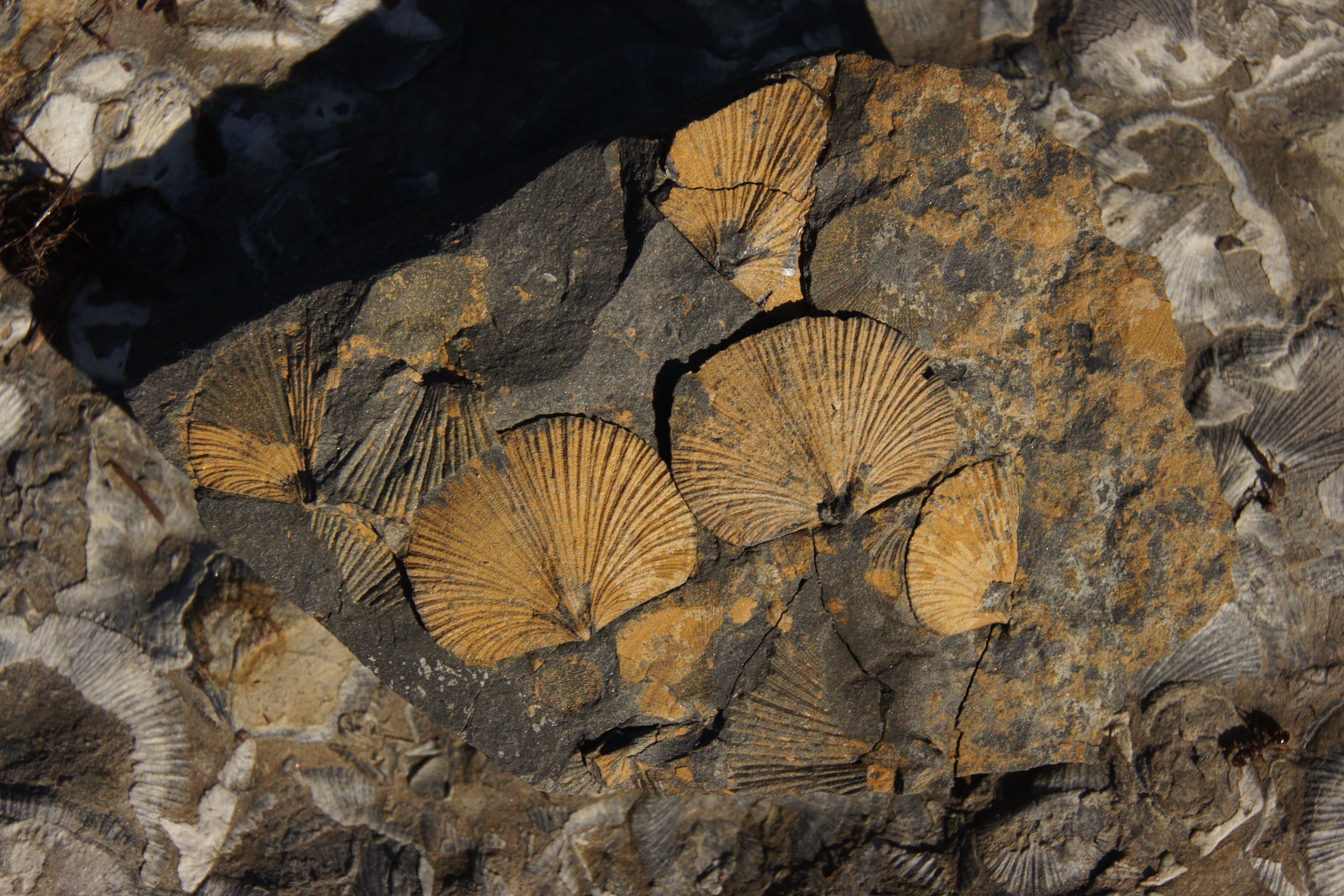
Plate with 2 small probable Onniella meeki brachiopods
Fossiliferous plate with two probable Onniella meeki brachiopods
Animalia
Brachiopoda
Strophomenata
Strophomenida
Scientific identification
- Common name
- Small strophomenide brachiopod
- Author
- Denis Arcand
The specimen corresponds to a small plate bearing two probable brachiopods attributable to Onniella meeki. The valves appear small, subtriangular to subrounded, with a morphology compatible with an Ordovician strophomenide.
Supported by: The filename explicitly provides Onniella meeki as the principal taxon, and the BRA code indicates that the main fossil of interest belongs to the Brachiopoda. The count '_2_' suggests two principal individuals on the plate.
Species-level confirmation requires: A more robust species confirmation would require direct observation of valve convexity, ornamentation, hinge line, and ideally comparison with regional reference material.
Certainty: Identification interpreted from the filename and the BRA code. The principal taxon is treated as Onniella meeki, but fine confirmation would require examination of ornamentation, shell profile, and hinge characters on the actual specimen.
Geology and provenance
- Formation
- Nicolet River Formation
- Group
- Lorraine Group
- Locality
- Écluse de Chambly
- Region
- Richelieu Valley
- Province
- Quebec
- Country
- Canada
Lithostratigraphy
Locality: CEDC- Chambly Écluse de Chambly
Region: Richelieu Valley
Formation: Nicolet River Formation
Group: Lorraine Group
Depositional environment: Soft muddy seafloor
Note: The RTHQ site code is known in the nomenclature as a shale site, but the detailed formation is not forced here.
Observed lithology
Description: Dark gray to black shale, finely laminated, serving as support for two small probable brachiopods.
Interpretation: Fine siliciclastic sediment deposited in a calm marine setting.
Certainty: High confidence
Physical description
Assemblage description: Small fossiliferous plate bearing two probable Onniella meeki brachiopods on a fine shale matrix. The specimen appears centered on a small number of well-individualized specimens rather than on a diffuse debris concentration.
Associated fossils: No distinct associated fossils are confirmed by the filename; possible secondary bioclasts are not interpreted here.
Matrix description
Fossil assemblage: Sparse shelly assemblage
Fossil density: Low
Species composition: Mixed / uncertain
Plate surface: Weathered
Relief: High relief
Ornamentation: Fine growth lines
Rock type: Calcareous Shale
Color: Brown / Dark gray - Mottled - Medium-dark
Shape: Sub-rounded block
Dimensions: W 5.08 × L 5.08 × T 1.5 cm (centimeters)
Approximate volume: 38.7 cm (centimeters)³
Weight: 0.12 Gramme
Note: The specimen appears dominated by a single principal taxon, with two probable individuals of Onniella meeki.
Additional note: Dimensions derived from the 2x2 code in the filename, interpreted in inches according to the nomenclature. Thickness and weight remain approximate and should be validated on the specimen.
Taphonomy
Summary: Two probable brachiopods preserved on a small Ordovician shale plate, with preservation mainly in low relief on a bedding surface.
Evaluator: Paleontologist
Transport origin: Indeterminate
Occurrence position: Reworked
Articulation: Moderate
Fragmentation: High
Abrasion: Low
Compression: Low
Observed processes: Small brachiopods preserved on a thin shale plate; the specimen seems to represent simple preservation on matrix rather than a complex taphonomic concentration.
Interpretation: The specimen appears to correspond to a small shale plate bearing two brachiopods preserved in a calm, low-energy marine setting.
Taphonomic quality: B — Good preservation of a small identifiable specimen
Justification: The specimen seems less rich than a large assemblage plate, but it remains useful because the principal taxon is more directly identifiable.
Evaluation date: 2026-03-09T00:00:00
Palaeoecological interpretation
Interpretation: Benthic brachiopods living on or near the seafloor in a calm Ordovician muddy environment.
Hypothesis: The specimen may represent two small individuals preserved on a fine depositional surface, typical of a low-energy offshore marine environment.
Certainty: Moderate, mainly based on the filename and the general context of the RTHQ site.
Note: The ecological interpretation remains intentionally general in the absence of a detailed direct examination of the valves.
Conservation state
General state: Fair
Integrity: Fragmentary
Alterations: Matrix friability / Crumbling at touch (High)
Stability: Monitor closely
Scientific readability: Poor
Note: Specimen remains interpretable and displayable, but matrix friability requires cautious handling.
Museum exhibition value
Provenance: Type or figured specimen provenance documented
Aesthetic appeal: High aesthetic and educational value
Systematic collections: Systematic value not assessed
Note: Small specimen mainly useful for systematic collection and taxonomic comparison rather than for major exhibition.
Scientific value
Rarity / locality: Very common fossil taxon
Completeness / preservation: Poor preservation with limited diagnostic features
Taxonomic novelty: Not evaluated for taxonomic novelty
Note: Moderate scientific interest as a small Ordovician brachiopod specimen identified at least plausibly from the filename.
Public exhibit text
This small plate preserves two probable brachiopods. Brachiopods were marine animals attached to or resting on the seafloor, very common in Ordovician seas.