0694_UNKN_ORD_BIV_PLT_ZS_EX_Ambonichia_1_4x6
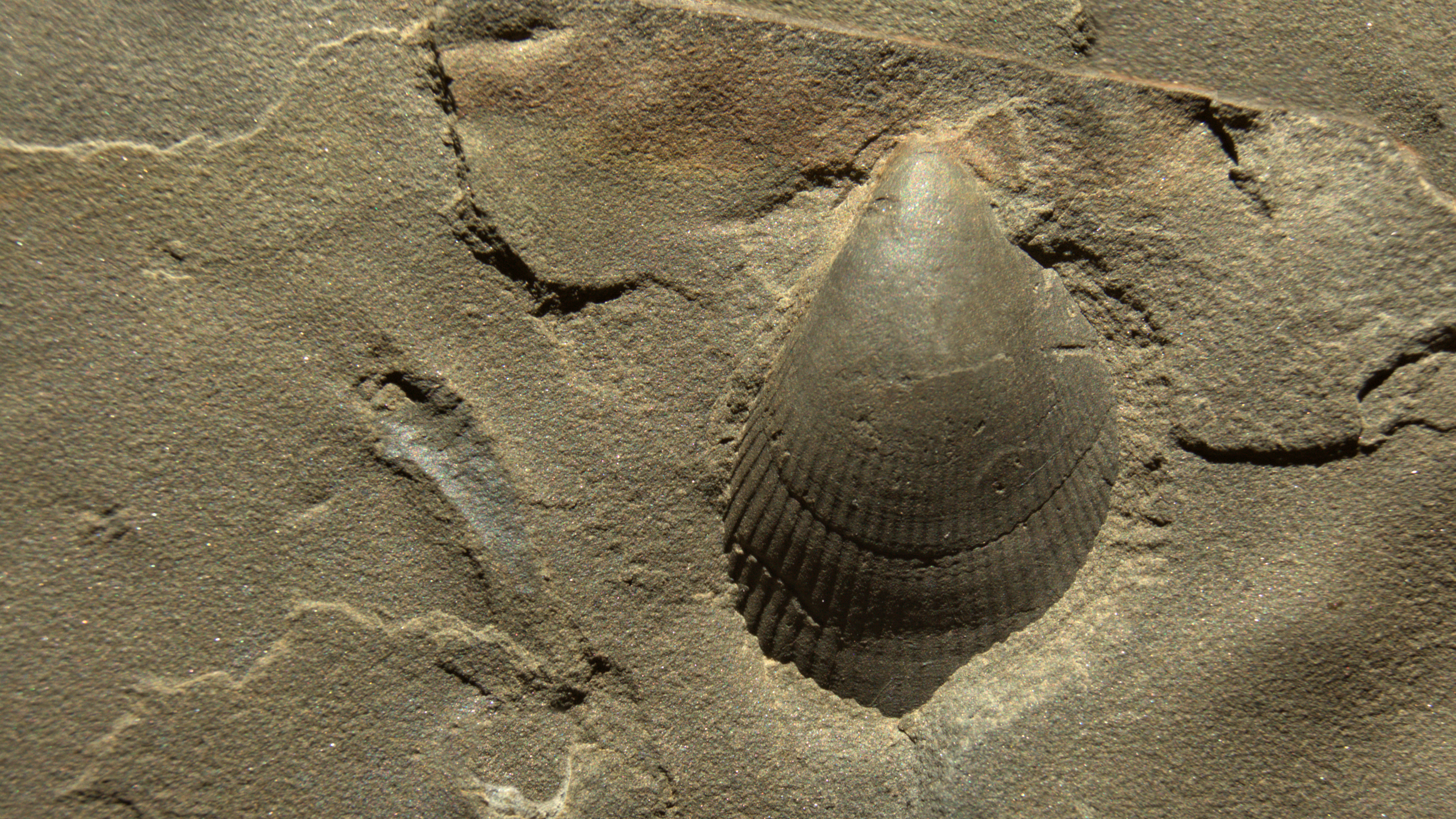
Plate with Ambonychia
Fossiliferous plate with Ambonychia bivalve
Animalia
Mollusca
Bivalvia
Myalinida
Scientific identification
- Family
- Ambonychiidae
- Common name
- Ambonychia bivalve
- Author
- Denis Arcand
Specimen interpreted as a bivalve assigned to Ambonychia, preserved on a shale plate.
Supported by: Filename taxonomic keyword 'Ambonichia/Ambonychia' and bivalve code BIV indicate a bivalve specimen rather than an echinoderm concentration.
Species-level confirmation requires: Better preserved hinge, shell outline, ornamentation, and diagnostic morphological details.
Certainty: Identification considered reliable at genus level from filename and specimen context; species not assigned.
Geology and provenance
- Formation
- Nicolet River Formation
- Group
- Lorraine Group
- Locality
- Écluse de Chambly
- Region
- Richelieu Valley
- Province
- Quebec
- Country
- Canada
Lithostratigraphy
Locality: CEDC- Chambly Écluse de Chambly
Region: Richelieu Valley
Formation: Nicolet River Formation
Group: Lorraine Group
Depositional environment: Soft muddy seafloor
Note: Exact site and stratigraphic unit unknown; only Ordovician age and bivalve context retained.
Observed lithology
Description: Dark shale slab preserving a bivalve fossil.
Interpretation: Fine-grained marine siliciclastic sediment.
Certainty: High confidence
Physical description
Assemblage description: Shale plate preserving a visible Ambonychia specimen or shell impression.
Associated fossils: No associated fossils confidently identified from the current record.
Matrix description
Fossil assemblage: Sparse shelly assemblage
Fossil density: Low
Species composition: Mixed / uncertain
Plate surface: Weathered
Relief: High relief
Ornamentation: Fine growth lines
Rock type: Calcareous Shale
Color: Brown / Dark gray - Mottled - Medium-dark
Shape: Sub-rounded block
Dimensions: W 10.2 × L 15.2 × T 1.5 cm (centimeters)
Approximate volume: 0.2 cm (centimeters)³
Weight: 0.3 Gramme
Note: Plate centered on a single Ambonychia bivalve specimen.
Additional note: Plate dimensions derived from filename code 4x6 inches, converted to centimeters.
Taphonomy
Summary: Bivalve shell preserved on a shale plate; exact degree of transport and reworking uncertain.
Evaluator: Paleontologist
Transport origin: Indeterminate
Occurrence position: Reworked
Articulation: Moderate
Fragmentation: High
Abrasion: Low
Compression: Low
Observed processes: Single shelly fossil preserved on a shale plate, with limited contextual taphonomic information available.
Interpretation: The specimen likely represents a shelly bivalve preserved in low-energy muddy marine sediment.
Taphonomic quality: C — Moderately informative preservation of a shelly fossil on matrix
Justification: The specimen is useful for identification and collection purposes, but locality and detailed taphonomic context remain uncertain.
Evaluation date: 2026-03-09T00:00:00
Palaeoecological interpretation
Interpretation: Marine benthic bivalve from an Ordovician muddy shelf environment.
Hypothesis: Ambonychia likely lived on or near the substrate in a marine setting.
Certainty: Moderate.
Note: Interpretation remains general because provenance is unknown.
Conservation state
General state: Fair
Stability: Monitor closely
Scientific readability: Poor
Note: Specimen remains interpretable and displayable, but matrix friability requires cautious handling.
Museum exhibition value
Provenance: Type or figured specimen provenance documented
Aesthetic appeal: High aesthetic and educational value
Systematic collections: Systematic value not assessed
Note: Good display value as a recognizable Ordovician bivalve on shale matrix.
Scientific value
Completeness / preservation: Poor preservation with limited diagnostic features
Taxonomic novelty: Not evaluated for taxonomic novelty
Note: Useful collection specimen of an Ordovician bivalve, but provenance is unknown.
Public exhibit text
This plate preserves a bivalve attributed to the genus Ambonychia, a marine mollusk that lived in Ordovician seas.