0706_RPMF_ORD_ECH_PLT_JZ_EX_Ossicles_40_3.5x4.5
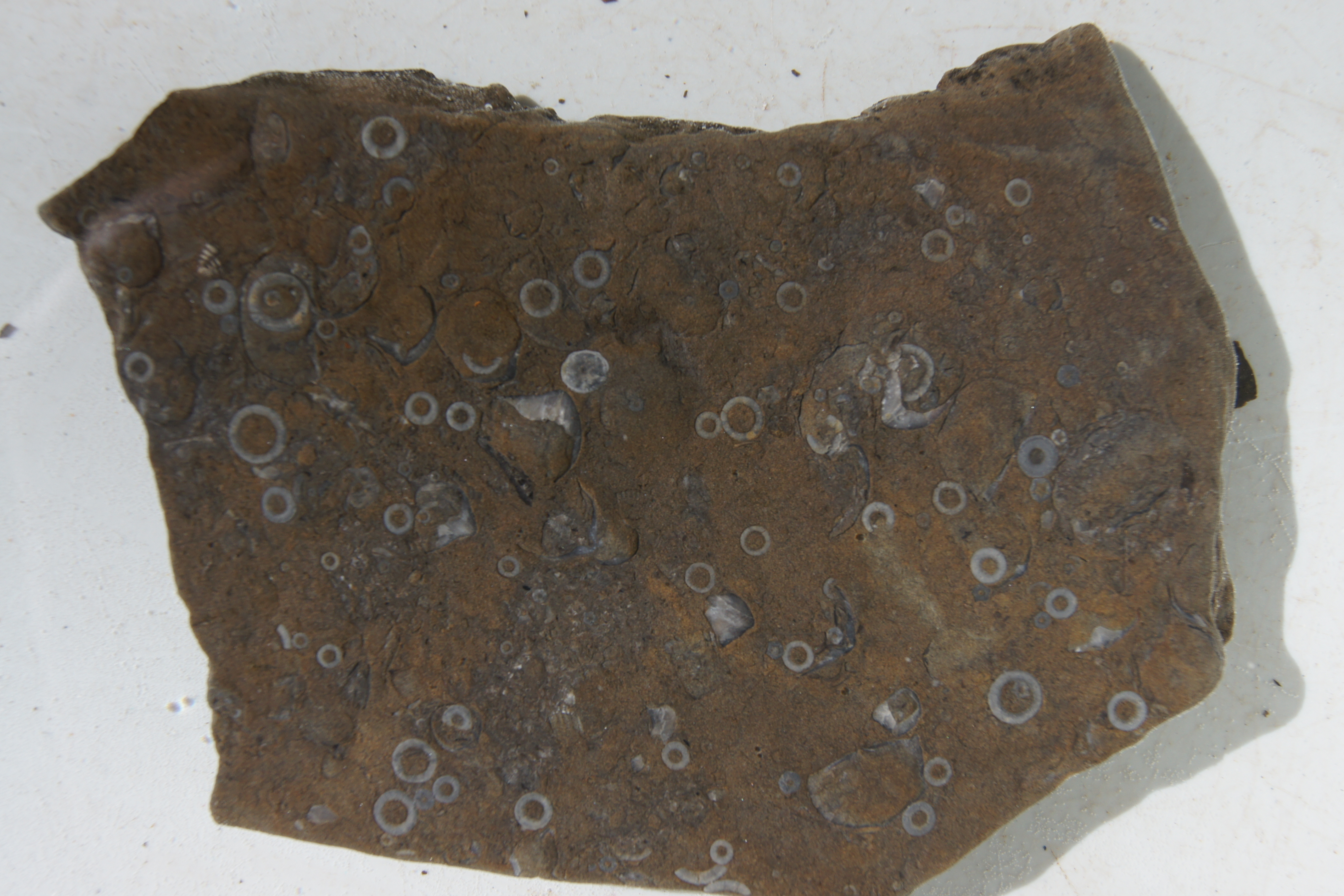
Plate with numerous echinoderm ossicles
Fossiliferous plate with numerous echinoderm ossicles
Animalia
Echinodermata
Crinoidea
Scientific identification
- Common name
- Crinoid ossicles
- Author
- Denis Arcand
The specimen consists of numerous isolated echinoderm ossicles preserved on a shale plate. Most visible elements are compatible with crinoid columnals or related skeletal debris, but no articulated crown, calyx, arms, or other diagnostic parts are visible.
Supported by: Abundant discoidal to subpolygonal calcareous ossicles with echinoderm appearance, consistent with disarticulated crinoid skeletal debris.
Species-level confirmation requires: Articulated or more diagnostic skeletal material such as calyx plates, pluricolumnals, brachials, or associated crowns.
Certainty: Identification is secure at phylum level and probable at class level; isolated ossicles do not permit a more precise taxonomic assignment.
Geology and provenance
- Formation
- Nicolet River Formation
- Group
- Lorraine Group
- Locality
- Écluse de Chambly
- Region
- Richelieu Valley
- Province
- Quebec
- Country
- Canada
Lithostratigraphy
Locality: CEDC- Chambly Écluse de Chambly
Region: Richelieu Valley
Formation: Nicolet River Formation
Group: Lorraine Group
Depositional environment: Soft muddy seafloor
Note: RPMF site code from the filename; the exact formation and group are not confirmed in the provided source files, but the lithology is consistent with an Ordovician shale setting.
Observed lithology
Description: Dark gray to black fossiliferous shale preserving numerous isolated echinoderm ossicles on bedding surfaces.
Interpretation: Fine-grained offshore siliciclastic sediment consistent with low-energy marine deposition.
Certainty: High confidence
Physical description
Assemblage description: Plate bearing a dense concentration of small echinoderm ossicles, visually dominated by crinoid-like skeletal debris scattered across a dark shale surface.
Associated fossils: No other associated macrofossils confidently identified on the exposed surface.
Matrix description
Fossil assemblage: Sparse shelly assemblage
Fossil density: Low
Species composition: Mixed / uncertain
Plate surface: Weathered
Relief: High relief
Ornamentation: Fine growth lines
Rock type: Calcareous Shale
Color: Brown / Dark gray - Mottled - Medium-dark
Shape: Sub-rounded block
Dimensions: W 8.9 × L 11.4 × T 1.5 cm (centimeters)
Approximate volume: 50.7 cm (centimeters)³
Weight: 0.3 Gramme
Note: The assemblage is visually dominated by echinoderm ossicles, most likely crinoid debris, but monospecificity cannot be confirmed from isolated skeletal elements.
Additional note: Dimensions derived from the filename code 3.5x4.5 (inches) and converted to centimeters.
Taphonomy
Summary: Dense concentration of disarticulated echinoderm ossicles preserved on a fine-grained shale plate.
Evaluator: Paleontologist
Transport origin: Indeterminate
Occurrence position: Reworked
Articulation: Moderate
Fragmentation: High
Abrasion: Low
Compression: Low
Observed processes: Numerous isolated ossicles accumulated on a single plate; the elements are disarticulated and likely represent concentrated skeletal debris.
Interpretation: The specimen likely records skeletal debris from echinoderms, probably crinoids, accumulated and buried in a low-energy muddy marine setting.
Taphonomic quality: C — Moderately informative preservation of disarticulated fossil debris
Justification: The specimen is useful as a taphonomic and sedimentological example of concentrated echinoderm debris, but diagnostic taxonomic information is limited.
Evaluation date: 2026-03-09T00:00:00
Palaeoecological interpretation
Interpretation: Disarticulated echinoderm skeletal debris preserved on a muddy marine substrate.
Hypothesis: The plate likely records local accumulation of crinoid-derived ossicles in a quiet offshore setting.
Certainty: Moderate.
Note: This specimen is primarily informative for preservation style, taphonomic concentration, and echinoderm presence.
Conservation state
General state: Fair
Integrity: Fragmentary
Alterations: Matrix friability / Crumbling at touch (High)
Stability: Monitor closely
Scientific readability: Poor
Note: The specimen remains interpretable and displayable, but matrix friability requires cautious handling.
Museum exhibition value
Provenance: Type or figured specimen provenance documented
Aesthetic appeal: High aesthetic and educational value
Systematic collections: Systematic value not assessed
Note: Moderate educational value as an example of concentrated echinoderm ossicles preserved on shale.
Scientific value
Rarity / locality: Very common fossil taxon
Completeness / preservation: Poor preservation with limited diagnostic features
Taxonomic novelty: Not evaluated for taxonomic novelty
Note: Useful as an Ordovician echinoderm debris plate and for documenting concentrated ossicle preservation in shale.
Public exhibit text
This plate shows an accumulation of small echinoderm skeletal elements, probably from crinoids. After the skeleton disarticulated, the calcareous pieces accumulated and were later buried in calm marine mud.