1365_MBAL_EOC_AMB_FRE_JS_EX_MER BALTIQUE_DIPTERE_1_1x2_Jean Luc gift
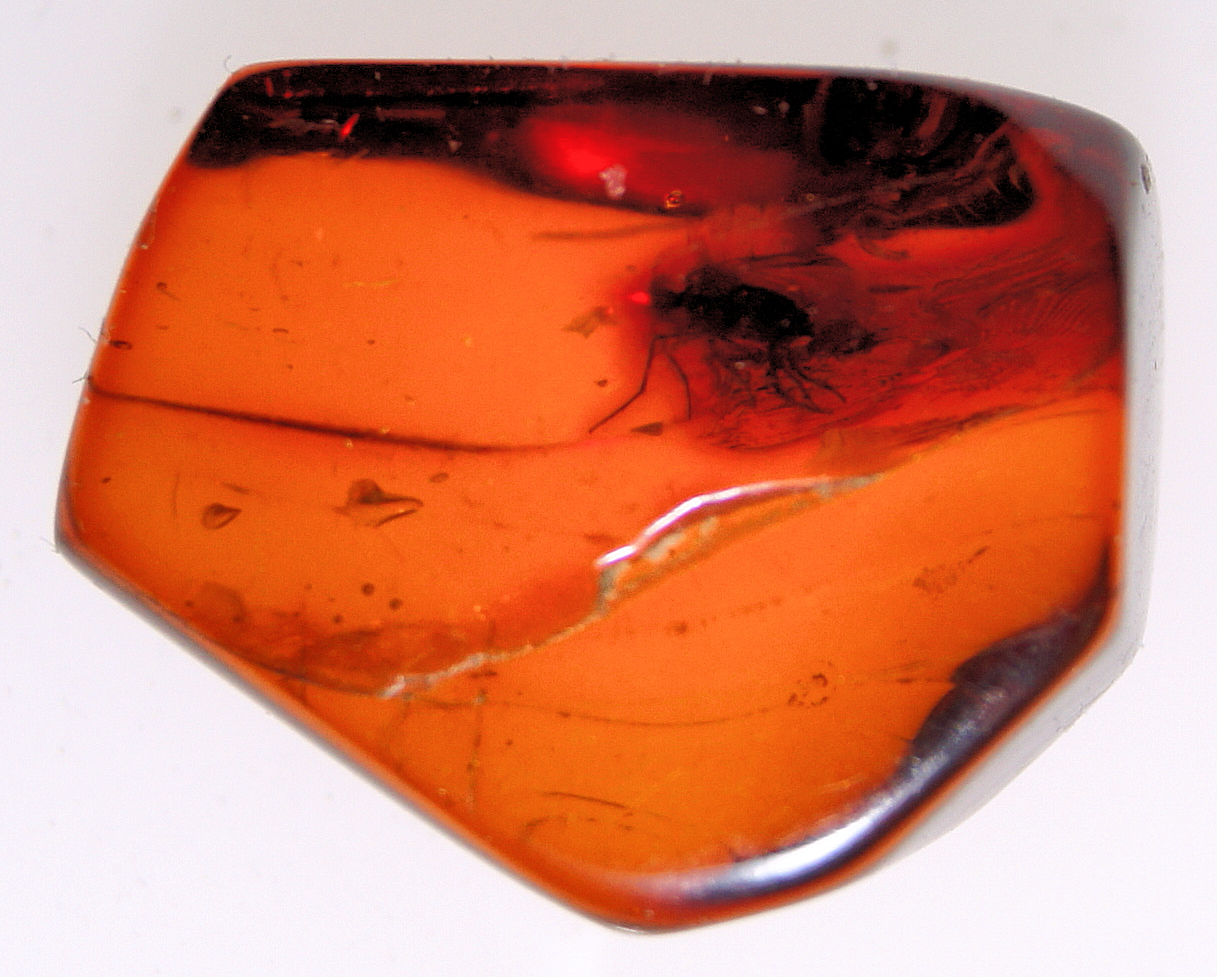
Baltic amber with dipteran inclusion
Baltic amber specimen with probable dipteran inclusion
Animalia
Arthropoda
Insecta (Linnaeus, 1758)
Diptera (Linnaeus, 1758)
Scientific identification
- Common name
- Fly inclusion in Baltic amber
- Author
- Denis Arcand
The specimen is a polished free amber piece containing one clearly visible arthropod inclusion, most likely a small dipteran insect. The inclusion appears preserved three-dimensionally within translucent orange to reddish amber.
Supported by: Visible wing-bearing insect-like body plan, slender appendages, compact body, and overall appearance consistent with a small fly preserved in amber.
Species-level confirmation requires: Higher magnification views, multiple angles, and closer observation of wing venation, antennae, thoracic structure, and leg morphology.
Certainty: Identification is reasonably secure at the insect level and probable at the dipteran level based on the visible inclusion, but diagnostic details are insufficient for family- or genus-level determination from the current image alone.
Geology and provenance
- Formation
- Nicolet River Formation
- Group
- Lorraine Group
- Locality
- Écluse de Chambly
- Region
- Richelieu Valley
- Province
- Quebec
- Country
- Canada
Lithostratigraphy
Locality: CEDC- Chambly Écluse de Chambly
Region: Richelieu Valley
Formation: Nicolet River Formation
Group: Lorraine Group
Depositional environment: Soft muddy seafloor
Note: Baltic amber provenance is recorded from the filename and user instruction, but a precise stratigraphic unit is not provided in the current documentation.
Observed lithology
Description: Translucent orange to reddish fossil resin (amber), polished as a free specimen and containing a visible insect inclusion.
Interpretation: Amber representing fossilized tree resin rather than a lithified sedimentary matrix.
Certainty: High confidence
Physical description
Assemblage description: Single free amber specimen with one principal insect inclusion and a few tiny non-diagnostic particulate or organic inclusions.
Associated fossils: No additional diagnostic macro-inclusions are confidently confirmed from the current image.
Matrix description
Fossil assemblage: Sparse shelly assemblage
Fossil density: Low
Species composition: Mixed / uncertain
Plate surface: Weathered
Relief: High relief
Ornamentation: Fine growth lines
Rock type: Calcareous Shale
Color: Brown / Dark gray - Mottled - Medium-dark
Shape: Sub-rounded block
Dimensions: W 2.5 × L 5.1 cm (centimeters)
Note: Although originally designed for rock-hosted fossils, these fields are here adapted to a free amber specimen containing a single main insect inclusion.
Additional note: Dimensions derived from filename metadata (1 x 2 inches) and converted approximately to centimeters.
Taphonomy
Summary: Probable dipteran insect trapped in resin and preserved three-dimensionally within Baltic amber.
Evaluator: Paleontologist
Transport origin: Indeterminate
Occurrence position: Indeterminate
Articulation: High
Fragmentation: Low
Abrasion: None
Compression: None
Observed processes: The arthropod was trapped in sticky tree resin, then sealed and preserved within fossilized amber. A visible internal fracture crosses the amber, but the inclusion remains readable.
Interpretation: This specimen records biological entrapment of a small probable fly in tree resin, later fossilized as amber and ultimately recovered from Baltic amber deposits or shoreline-derived material.
Taphonomic quality: B+ — Good three-dimensional inclusion with useful visible morphology
Justification: The amber is attractive and the main inclusion is clearly visible, but the current image does not preserve enough diagnostic detail for fine taxonomic resolution.
Evaluation date: 2026-04-05T00:00:00
Palaeoecological interpretation
Interpretation: Arthropod from an Eocene amber-producing forest ecosystem, preserved in fossil resin rather than sedimentary rock matrix.
Hypothesis: The inclusion most likely represents a small flying insect living in or near a resin-producing forest around the Baltic amber source area.
Certainty: Moderate; broad ecological interpretation is secure, but fine taxonomic and habitat detail remain uncertain from the present image alone.
Note: This specimen is especially informative for amber taphonomy, paleoentomology, and public interpretation of resin entrapment.
Conservation state
General state: Good
Stability: Mostly stable
Scientific readability: Good
Note: The specimen shows a visible internal fracture plane but remains visually stable and scientifically readable.
Museum exhibition value
Provenance: General locality known only
Aesthetic appeal: High aesthetic and educational value
Systematic collections: Systematic value not assessed
Note: The specimen has strong exhibition appeal because of its color, transparency, and clearly visible insect inclusion.
Scientific value
Completeness / preservation: Moderately preserved but identifiable
Taxonomic novelty: Not evaluated for taxonomic novelty
Note: The specimen is scientifically useful as a documented amber inclusion, especially for paleoentomological and taphonomic interpretation, but the current image does not support fine taxonomic resolution.
Public exhibit text
This polished amber piece preserves a tiny insect, most likely a fly, trapped in sticky tree resin millions of years ago. The resin later fossilized and became amber, creating a remarkable natural time capsule.